
Book-Matched Marble: What It Is and Why It Costs More
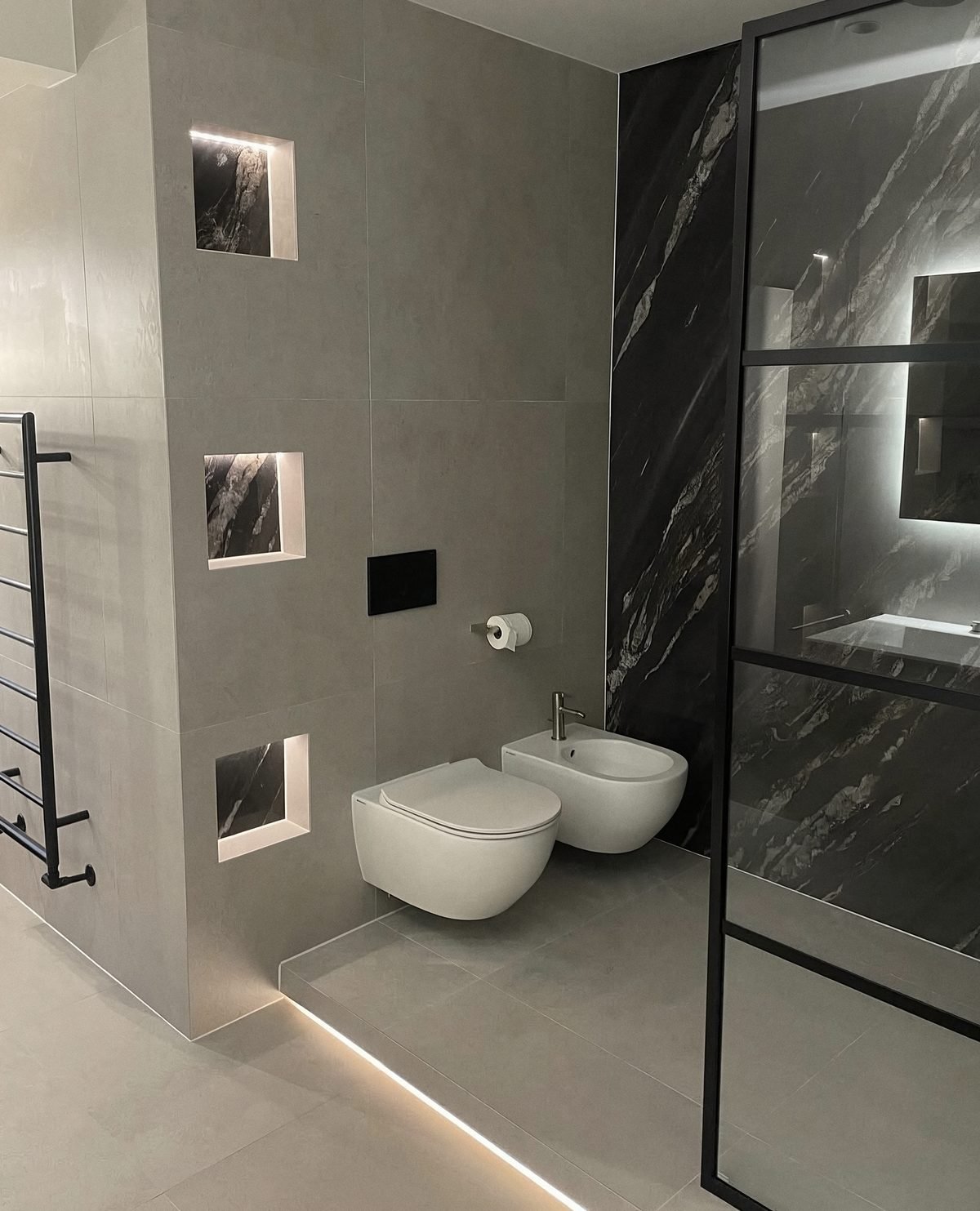
Book-matched marble is one of those features that stops people in a doorway, a single, striking, symmetrical pattern running across a wall as if it were folded open like a book. It's also one of the more misunderstood natural stone techniques, with a lot of people not quite sure what makes it different from just tiling with marble. Here's what's actually involved.
What Book-Matching Actually Means
Every slab of natural marble has its own unique veining, formed by the mineral deposits and geological pressure that created the stone over millions of years, no two slabs are identical. Book-matching takes two slabs cut sequentially from the same block, so their veining patterns are near mirror images of each other, and installs them side by side with one flipped, so the veining meets at the join and forms a symmetrical, almost butterfly-like pattern across the two pieces. Done well, it genuinely looks like a single continuous image rather than two separate pieces of stone, with the veining flowing outward from the centre join in a way that reads as deliberate and dramatic rather than accidental. It's the same principle used in high-end joinery and veneer work with book-matched wood grain, applied to stone.
Why It Requires Buying and Cutting From the Same Slab
This is the part that drives the cost. Book-matching only works with slabs cut consecutively from the same block of stone, because that's the only way the veining pattern lines up closely enough to mirror convincingly. You can't achieve the effect by picking two similar-looking marble tiles off a shelf, the veining has to genuinely come from adjacent cuts. That constrains the buying process significantly. You're not choosing from a wide range of stock; you're sourcing specific consecutive slabs, which limits your options and generally costs more than standard natural stone bought more freely. There's also more wastage involved in getting the match right, offcuts and trims that would be usable elsewhere on a standard job often can't be repurposed here, because the priority is preserving the continuity of the veining across the join rather than minimising waste.
Why a Skilled Fitter Matters More Here Than Almost Anywhere Else
Laying book-matched marble isn't like laying a standard natural stone wall. The two pieces have to be positioned with real precision so the veining actually lines up at the join, get the alignment even slightly wrong and the whole point of the exercise is lost, because the eye picks up on a mismatched pattern far more readily than it would notice an ordinary tile out of true. It also demands the same natural stone care as any marble installation, proper handling to avoid chipping the edges that will sit at the visible join, and sealing once it's fitted, since marble needs sealing roughly once a year to keep performing and resisting the etching and scratching it's more prone to than porcelain. Getting the technical fitting right and getting the pattern-matching right are two separate skills that both need to be present on the same job.
Already sure this is the job you want done properly? Call us directly, no need to read on.
Where It Makes the Most Visual Impact
Book-matched marble earns its place as a single feature wall, not as a whole-room treatment. A bathroom feature wall behind a bath or vanity, for instance, gives the pattern room to be seen and appreciated as a deliberate centrepiece, rather than being diluted across an entire room where the eye has too much else competing for attention. Used sparingly like this, it also sits well against simpler, calmer materials elsewhere in the same room, porcelain on the floor, plain tiling on the remaining walls, so the book-matched wall reads as the obvious focal point rather than one busy surface among several. Trying to book-match an entire room, floor to ceiling, tends to lose the effect entirely and just becomes visually overwhelming, on top of being considerably more costly to source and fit.
How It Compares to a Standard Natural Stone Install
A standard natural stone installation, marble, travertine, limestone or granite, laid in the normal way, still gives you a genuinely premium, characterful finish, since every piece of natural stone carries its own natural veining and variation regardless of how it's matched. It's just laid without the specific requirement of consecutive slabs and mirrored alignment, which makes it more flexible to source and generally more straightforward, and less costly, to fit well. Book-matching is a deliberate step up from that: same base material, same maintenance considerations, but a specific technique layered on top that turns natural variation into a designed symmetrical statement.
Book-matched marble is a genuinely striking feature when it's sourced and fitted properly, and a disappointing one when it isn't quite lined up. We've fitted book-matched marble feature walls as part of bathroom renovations across Wilmslow, Alderley Edge and Cheshire, working closely with the stone supplier to get consecutive slabs sourced correctly before fitting even starts. See our Bathroom Tiling page for how we approach this on a real job. Or get a free quote if you already know what you need.
Frequently asked
Questions worth answering upfront.
Any marble with visible veining can technically be book-matched, but the effect is most dramatic with stone that has strong, distinct veining rather than a very uniform, subtle pattern, the more visible the veining, the more striking the mirrored effect.
Because the veining needs to come from two consecutive cuts of the same block to mirror convincingly at the join. Two slabs that simply look similar won't line up the same way, and the mismatch is usually obvious once installed.
No, the maintenance is the same as any natural stone, sealing roughly once a year and a bit more care around acidic spills than you'd need with porcelain. The extra effort with book-matching is all in the sourcing and fitting, not the ongoing care.
It's almost always done on walls, particularly a single feature wall, because that's where the symmetrical pattern is seen properly and appreciated as a whole. It's rarely worth doing on a floor, where furniture, sanitaryware and foot traffic break up the visual effect anyway.