
What Actually Changes the Cost of Tiling a Bathroom
Ask five different tiling companies what a bathroom costs and you'll get five different answers, because the honest truth is that no two bathrooms are the same job. A high-end bathroom tiled to a good standard typically comes in around £2,000-2,500, but that figure moves depending on what you're asking for. Here's what genuinely drives that price up or down, so you can go into a quote with realistic expectations rather than guessing.
The £2,000-2,500 Starting Point
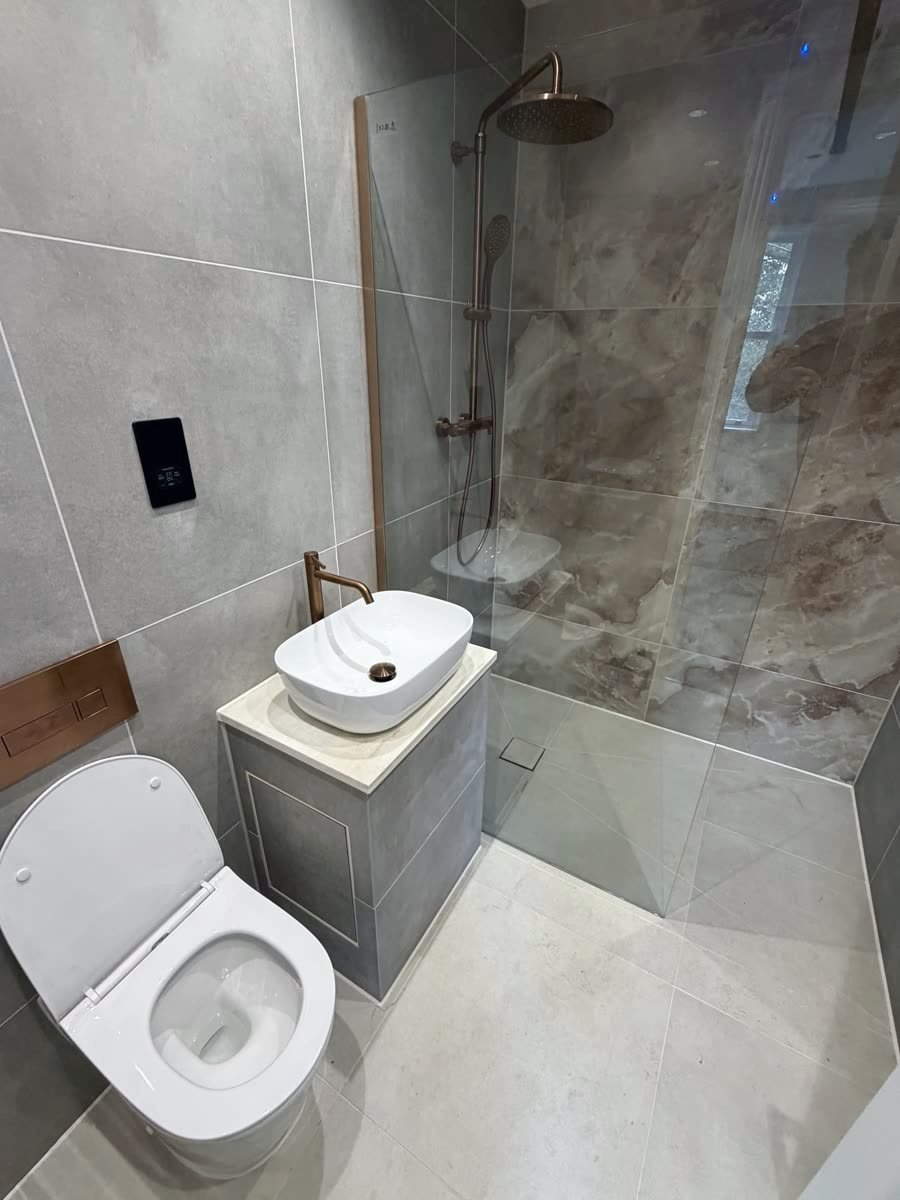
For a well-specified, high-end bathroom, decent porcelain or natural stone, proper waterproofing, a tiler who knows what they're doing, £2,000 to £2,500 is a realistic ballpark for a typical UK bathroom. That figure covers a standard-sized family bathroom finished to a high standard, not a poorly fitted budget job and not a huge wet room with multiple statement walls. Treat it as an anchor point rather than a quote. Every bathroom has its own combination of size, material, layout and existing condition, and each of those pulls the number in a different direction. The only way to get a figure that actually applies to your bathroom is a site visit, which is why we do them for free and turn quotes around within 24 hours. What follows is what tends to move that anchor figure up or down, so you're not going into that conversation blind.
Room Size and Shape
More square metres of tile obviously means more material and more labour, but size isn't just about floor area. An awkward-shaped bathroom with lots of corners, a boxed-in bath panel, a WC in an alcove, or pipework boxing to tile around takes longer than a simple rectangular room of the same size, because every cut and every internal corner adds time. A bathroom with a separate shower enclosure, a bath, and tiled walls around both will cost more than the same footprint tiled to waist height only. It's worth being realistic with a tiler about which walls you actually want tiled and to what height before assuming size alone sets the price: two bathrooms of identical square footage can end up at very different price points depending on how much of that space is actually being tiled and how fiddly the layout is.
Material Choice
Porcelain, natural stone, ceramic and mosaic all behave differently to work with, and that shows up in the price. Large-format porcelain slabs (we regularly fit up to 1200x600mm) mean fewer grout lines and a cleaner look, but they're heavier and less forgiving to handle and cut than smaller tiles, and an uneven wall or floor needs more prep to take them properly. Natural stone, marble, travertine, limestone, granite, needs sealing to protect it, generally about once a year, and it's more prone to scratching and etching than porcelain, which affects both the fitting process and what you're signing up for afterwards. Ceramic is usually easier to cut into detailed patterns, but it's less impact-resistant than porcelain, so it suits walls better than a busy floor. None of these is "wrong". It's a genuine trade-off between look, durability and maintenance, and it's one of the biggest levers on the final cost.
Already sure this is the job you want done properly? Call us directly, no need to read on.
Layout Complexity
A standard grid layout, tile after tile in straight rows, is the fastest and most cost-effective way to tile a room. The moment you move to herringbone, chevron, brick-bond with an offset, or a mix of tile sizes and patterns, the job slows down. Herringbone in particular means far more cuts, more waste, and much more care taken to keep lines straight and consistent across the room, which adds labour time even though the material cost might be similar. That's not a reason to avoid it, a well-executed herringbone floor or feature wall looks genuinely different to a grid layout, but it's worth knowing that the pattern itself, not just the tile you choose, is a real cost driver.
Prep Work and What's Already There
What's underneath the new tiles matters as much as what's going on top. If old tiles need stripping out first, that's extra time and mess before the job even starts, and it sometimes reveals a floor or wall that needs levelling before anything gets fitted. Any wet area around a bath or shower needs proper tanking, full waterproofing of the surface before a single tile goes down, and that's not an optional extra, it's what stops water getting into the structure behind the tiles. If you're adding underfloor heating, the tiling has to be done correctly around the heating mats so nothing gets damaged and the finished floor still heats evenly. All of this is invisible once the job's finished, but it's often where the bulk of the time goes on a renovation, particularly on an older property where nothing's quite level or square to start with.
If you want a proper answer for your specific bathroom rather than a rough figure, book a free site visit. We'll usually get a quote back to you within 24 hours, and jobs typically get booked in within around two weeks of a confirmed quote. See our Bathroom Tiling page for how we approach this on a real job. Or get a free quote if you already know what you need.
Frequently asked
Questions worth answering upfront.
Not necessarily. A small bathroom with an awkward shape, lots of pipe boxing, or a complex layout can take longer per square metre than a larger, simpler room. Size is one factor among several, not the whole story.
It's usually a more involved material to work with and needs ongoing sealing once it's down, which affects the whole-life cost rather than just the fitting price. Porcelain doesn't need sealing at all, which is worth factoring in if low maintenance matters to you.
It depends on size, material and how much prep work is needed, but once a quote's confirmed, we typically get jobs booked in within around two weeks.
No. That's exactly the sort of thing to flag on the site visit. We'll assess what's there and factor removal into the quote rather than you needing to prep anything beforehand.